Triple barrier protection plus anti-debris protection. Two lubrication pools to protect against high speed abrasion. Ultimate durability. Chain Series: ZXW, XRE, EXW
U-RING
Double barrier protection with enhanced long chain life similar to O-ring chains but with 65% less friction. Chain Series: MRU, HRU
UW-RING
Triple barrier protection plus anti-debris protection. Over 30% longer chain life compared to U-ring sealed chains with 5% less friction. Chain Series: UWR, MXU
RK MOTORCYCLE CHAINS CHAIN PLATE INFORMATION
Plate Wear Info
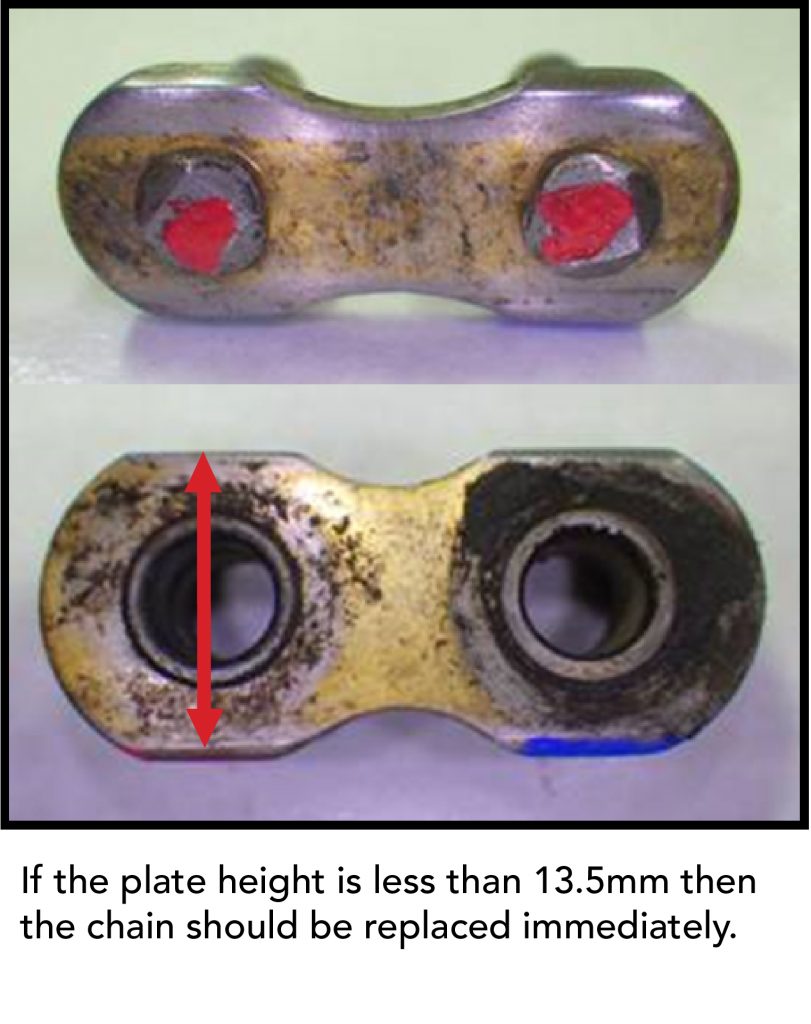
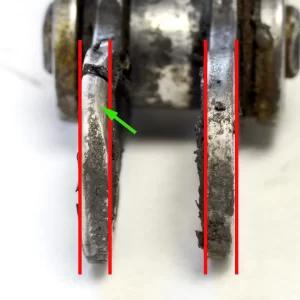
Why do chains break? There are many factors that can result in chain breakage. One type of breakage only seen in ATV and Off-Road applications is called “Plate Wear”. On a new chain, the plate should have a round shape very similar to the outline of a peanut. As the chain wears, the rounded tops and bottoms of the plate can wear flat. If this wear gets to a certain level, the chain will lose tensile strength. It is this loss of tensile strength that can cause the chain to break while the chain is under load.
It is most common for the inner side of the plate to wear out faster than the outer side of the plate; so when inspecting your chain, look over all parts of the chain to make sure that the inner side plate height is above 13.5mm in height for 520EXW, 520MAX-X and 520MAX-O. If the plate height is less than 13.5mm then the chain should be replaced immediately.
OFF-ROAD CHAIN HEAT CRACKING INFORMATION
THERMAL CRACKING
In off-road riding, even if the chain is installed correctly, repeated falls, excessive vibrations, rocks, and vehicle parts can cause problems with the chain.
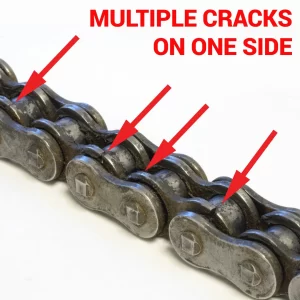
These pictures show a phenomenon called thermal cracking.
Thermal cracking results when the chain repeatedly contacts foreign objects and the side plates fracture as a result of the repeated heating and cooling from contact with the object.
Thermal cracking can occur for example when the chain comes in contact with a worn slider on the swing arm, or when the chain continues to come in contact with debris that has accumulated on the chain guide.
When riding off-road, the chain will operate in rougher conditions because the road surface is not flat, so if the chain width is narrow, it is more likely to hit somewhere on the vehicle body. The narrower the chain, the more likely it is to hit somewhere on the vehicle.
In the case of the chain in the photo shown here, one of the plates has been cut off at an angle. Under conditions without any impingements or contact with the vehicle components, the chain should be worn evenly.
In such a case, there is a high possibility that the chain is in contact with something on the vehicle itself. In this situation we recommend inspecting the entire drive system and removing or adjusting the area contacting the chain before installing a new chain.
INSPECT THE CHAIN GUIDE & COMPONENTS
Always Inspect the Chain Guide
When cleaning and maintaining your chain, always inspect the condition of the chain sliders. Excessively worn sliders or exposed components can come into contact with the chain, leading to premature wear and/or more serious issues. Be sure to also check the slider located beneath the swingarm. Exposed bolts or damaged sliders can cause the chain to strike swingarm components repeatedly, potentially resulting in heat cracking of the chain plates.
COUNTING CHAIN LENGTH
COUNTING YOUR CHAIN’S LENGTH
An easy way of measuring your chain’s length is to count only the outer sideplate pins, as shown in the example. In the example, counting just the pins on the chain gives a total of 28 pins. However, once the master link is added, the chain becomes 30 pins, which means 30 links long. If you purchase 120 link chain, the chain will have 118 pins. Once you add the master link, the total will be 120.
Accurately counting your chain links is crucial, as you cannot add extra links if the chain is too short.